Materials Can Be Classified as Solids Liquids or Gases Based on Whether Their Shapes and
3.3: Classifying Matter According to Its State: Solid, Liquid, and Gas
- Page ID
- 161823
Learning Objectives
- To depict the solid, liquid and gas phases.
H2o tin can take many forms. At low temperatures (below \(0^\text{o} \text{C}\)), information technology is a solid. When at "normal" temperatures (betwixt \(0^\text{o} \text{C}\) and \(100^\text{o} \text{C}\)), it is a liquid. While at temperatures above \(100^\text{o} \text{C}\), water is a gas (steam). The state that water is in depends upon the temperature. Each state has its own unique set of concrete properties. Thing typically exists in one of three states: solid, liquid, or gas.
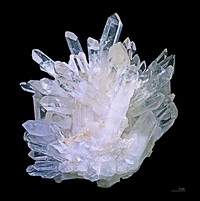
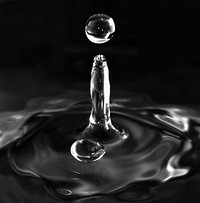
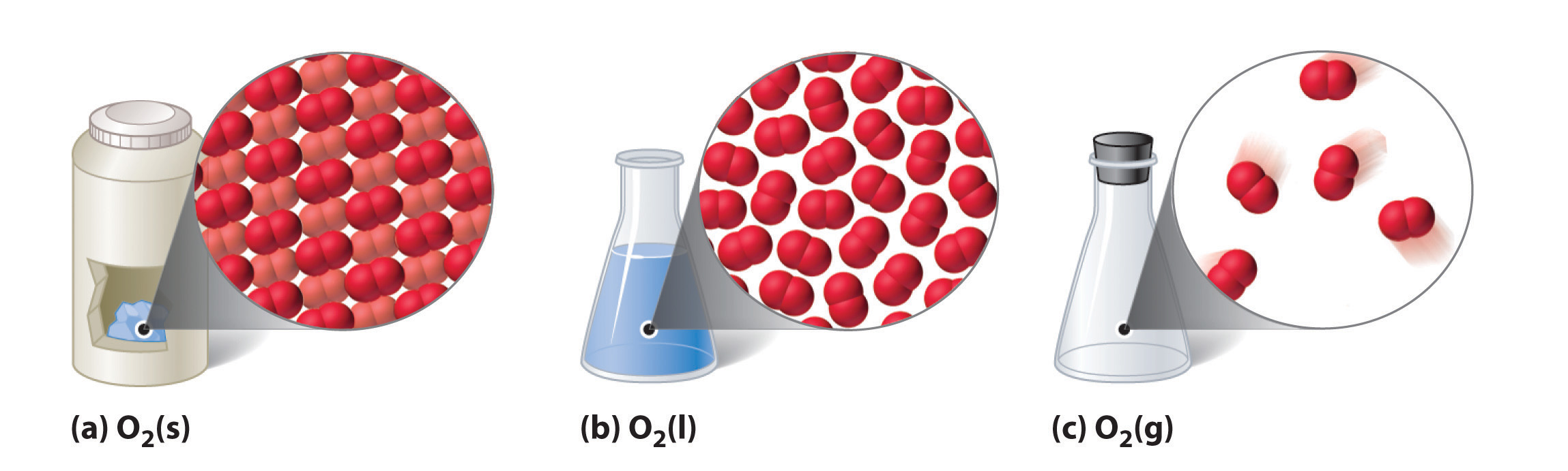
The state that a given substance exhibits is besides a physical holding. Some substances exist as gases at room temperature (oxygen and carbon dioxide), while others, like water and mercury metal, exist as liquids. Most metals exist as solids at room temperature. All substances tin be in any of these three states. Figure \(\PageIndex{2}\) shows the differences among solids, liquids, and gases at the molecular level. A solid has definite volume and shape, a liquid has a definite volume merely no definite shape, and a gas has neither a definite volume nor shape.
Plasma: A 4th Country of Thing
Technically speaking, a fourth state of matter called plasma exists, simply it does not naturally occur on earth, and so we will omit it from our study here.
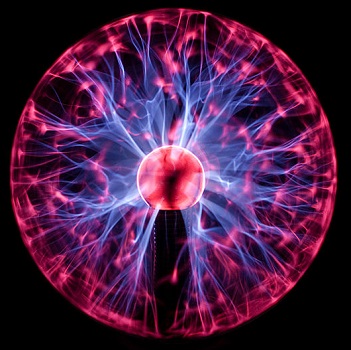.jpg?revision=1&size=bestfit&width=197&height=196)
A plasma world operating in a darkened room. (CC BY-SA 3.0; Chocolateoak).
Solids
In the solid state, the individual particles of a substance are in fixed positions with respect to each other because there is not enough thermal energy to overcome the intermolecular interactions between the particles. As a event, solids have a definite shape and book. Almost solids are hard, but some (similar waxes) are relatively soft. Many solids composed of ions can too be quite brittle.
Solids are divers by the following characteristics:
- Definite shape (rigid)
- Definite volume
- Particles vibrate around fixed axes
If we were to cool liquid mercury to its freezing signal of \(-39^\text{o} \text{C}\), and under the correct pressure conditions, we would notice all of the liquid particles would go into the solid state. Mercury can be solidified when its temperature is brought to its freezing point. Even so, when returned to room temperature atmospheric condition, mercury does not exist in solid country for long, and returns back to its more mutual liquid course.
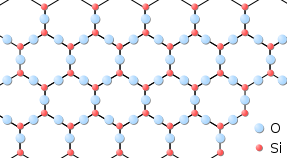
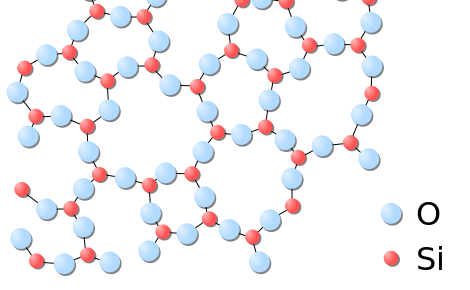
Solids normally have their constituent particles arranged in a regular, three-dimensional assortment of alternating positive and negative ions called a crystal. The effect of this regular arrangement of particles is sometimes visible macroscopically, equally shown in Figure \(\PageIndex{3}\). Some solids, particularly those composed of large molecules, cannot easily organize their particles in such regular crystals and exist equally amorphous (literally, "without form") solids. Glass is one example of an amorphous solid.
Liquids
If the particles of a substance have plenty energy to partially overcome intermolecular interactions, so the particles tin move about each other while remaining in contact. This describes the liquid state. In a liquid, the particles are notwithstanding in shut contact, so liquids have a definite volume. However, because the particles tin can move near each other rather freely, a liquid has no definite shape and takes a shape dictated by its container.
Liquids have the following characteristics:
- No definite shape (takes the shape of its container).
- Has definite volume.
- Particles are complimentary to move over each other, but are still attracted to each other.
A familiar liquid is mercury metal. Mercury is an anomaly. It is the only metal we know of that is liquid at room temperature. Mercury also has an power to stick to itself (surface tension)—a belongings that all liquids exhibit. Mercury has a relatively high surface tension, which makes it very unique. Here you run into mercury in its common liquid form.
Video \(\PageIndex{one}\): Mercury boiling to go a gas.
If we oestrus liquid mercury to its boiling point of \(357^\text{o} \text{C}\) under the right pressure weather, we would notice all particles in the liquid country go into the gas state.
Gases
If the particles of a substance have enough energy to completely overcome intermolecular interactions, then the particles can separate from each other and move well-nigh randomly in space. This describes the gas country, which nosotros will consider in more particular elsewhere. Like liquids, gases have no definite shape, only unlike solids and liquids, gases have no definite volume either. The change from solid to liquid normally does not significantly change the book of a substance. However, the change from a liquid to a gas significantly increases the book of a substance, by a gene of 1,000 or more. Gases take the following characteristics:
- No definite shape (takes the shape of its container)
- No definite volume
- Particles move in random motion with little or no attraction to each other
- Highly compressible
| Characteristics | Solids | Liquids | Gases |
|---|---|---|---|
| shape | definite | indefinite | indefinite |
| volume | definite | definite | indefinite |
| relative intermolecular interaction strength | strong | moderate | weak |
| relative particle positions | in contact and stock-still in identify | in contact just not fixed | not in contact, random positions |
Example \(\PageIndex{ane}\)
What state or states of matter does each argument, describe?
- This country has a definite book, but no definite shape.
- This land has no definite book.
- This country allows the individual particles to move about while remaining in contact.
Solution
- This statement describes the liquid state.
- This argument describes the gas state.
- This statement describes the liquid country.
Exercise \(\PageIndex{1}\)
What state or states of thing does each statement describe?
- This land has individual particles in a fixed position with regard to each other.
- This state has individual particles far apart from each other in infinite.
- This state has a definite shape.
- Answer a:
- solid
- Respond b:
- gas
- Answer c:
- solid
Summary
- Three states of thing exist—solid, liquid, and gas.
- Solids have a definite shape and volume.
- Liquids have a definite book, but take the shape of the container.
- Gases have no definite shape or volume.
Contributions & Attributions
This folio was constructed from content via the following contributor(southward) and edited (topically or extensively) past the LibreTexts development team to meet platform manner, presentation, and quality:
-
Marisa Alviar-Agnew (Sacramento Metropolis College)
-
Henry Agnew (UC Davis)
Source: https://chem.libretexts.org/Courses/can/intro/03%3A_Matter_and_Energy/3.03%3A_Classifying_Matter_According_to_Its_State%3A_Solid%2C_Liquid%2C_and_Gas
0 Response to "Materials Can Be Classified as Solids Liquids or Gases Based on Whether Their Shapes and"
Enregistrer un commentaire